Mote Ledger
Mote Ledger is a calm daily memory game. Each tray is a 3 by 3 grid of tiles, and every tile shows a shape, a Sprout, a Ring or a Kite, plus one, two or three dots. Study the tray for as long as you like, then cover it. Only then does the question appear: mark the three positions that held a given shape or a given number of dots. Eight trays make a daily set worth up to 24 points. There is no timer, a peek is allowed but counted, and your first daily score and streak are saved in your browser.
How to play
Tap or click Cover tray when you are ready. Tap three positions, or press keys 1 to 9 in reading order, then choose Record recall. Peek again shows the tray once more and is counted. Tab with Enter or Space also works.
Game credits
Provided by Nodavi Originals.
Available on desktop and mobile. An original Nodavi challenge. No third-party game bundle.
Ready when you are
Instant playA little break starts here.
An original daily challenge. Your streak stays on this browser. No ads or outside requests.
Nothing loads until you press Play.
The game opens here. Privacy & third-party games
Read the field guide: rules, tips & strategy ↓
How to Play Mote Ledger – Rules, Scoring and Memory Tips
Mote Ledger is a calm daily memory game. You study a small tray of tiles, cover it, and only then find out what you will be asked. There is no timer and no speed bonus, so it rewards attention rather than reflexes. Eight trays make a daily set, and everyone gets the same trays on the same UTC day. This guide explains the rules, how scoring works, and some simple memory techniques that make a perfect score much more likely.
How to play
Each tray is a 3 × 3 grid of nine tiles. Every tile has two features:
- a shape: a Sprout, a Ring or a Kite, and
- one, two or three dots.
On every tray, each shape appears on exactly three tiles, and each dot count also appears on exactly three tiles.
- Study the tray for as long as you like. The question is hidden at this point, so you need to notice both the shapes and the dots.
- Press Cover tray. The tiles are hidden and the question appears, for example “Mark the three Ring tiles” or “Mark the three tiles with 2 dots”.
- Mark three positions by tapping them, or by pressing keys 1 to 9, which follow reading order: 1 to 3 along the top row, 4 to 6 in the middle and 7 to 9 along the bottom.
- Press Record recall. The tray is revealed with each position labelled, so you can see which targets you found, which you missed and which marks were extra.
- Press Study next tray to continue. After the eighth tray, press Finish daily.
You can tap a marked position again to unmark it. You can never mark more than three.
Scoring
Each correct position is worth one point, so a tray is worth up to 3 points and the full set is worth up to 24. Your final result also shows how many trays you got perfectly right and how many times you peeked.
Peek again shows the covered tray once more and keeps the positions you have already marked. Peeking is allowed, but every peek is counted and appears in your result and your shared summary. The satisfying way to play is to aim for 24 with no peeks.
Each day’s set has four questions about shapes and four about dots, in a different order every day, so you cannot predict which feature a tray will ask about.
Memory techniques that help
Read the tray in rows. Go across the top row, then the middle, then the bottom, the same order as keys 1 to 9. A fixed scan order stops you from losing track of which tiles you have already looked at.
Say it, do not just see it. Quietly naming each row, such as “Ring two, Kite one, Sprout three”, uses words as well as the picture, and two kinds of memory are more reliable than one.
Use the “exactly three” rule. Because each shape and each dot count appears on exactly three tiles, you only need to remember two of the three groups for any feature. If you know where the Rings and Kites are, the Sprouts are whatever is left. The same works for dots.
Look for patterns. Three matching tiles often form a shape of their own: a line, a corner, a diagonal, or an L. “The Kites make a diagonal” is far easier to hold than three separate positions.
Remember shapes and dots together. Since you do not know the question in advance, try to build one picture per row that includes both features. If you only memorise shapes, half of the questions will catch you out.
Take your time. The instructions suggest about fifteen seconds of study per tray, but there is no clock. If a tray feels busy, study it for longer before you cover it. A whole set usually takes two to four minutes.
Using the review
After each recall, the revealed tray marks every position as a target you marked, a target you missed, or an extra mark. Spend a moment on it. If you keep missing the same kind of tile, such as the middle column or the dot counts, you know where to focus on the next tray.
Streaks and sharing
Your first finished result each day is saved in your browser along with your streak; no account is needed. Practice again lets you replay the day’s trays without changing that first result. Copy result copies your saved first score, perfect trays and peeks, with the UTC date, the game name and a link, but never the tray layouts, so friends can play the same set without spoilers. New trays start at 00:00 UTC; if the game is already open, reload it to get the new day.
If you enjoy careful, untimed puzzles, try Rill Rounds or Parcel Prism next.
A little more to explore
All games ↗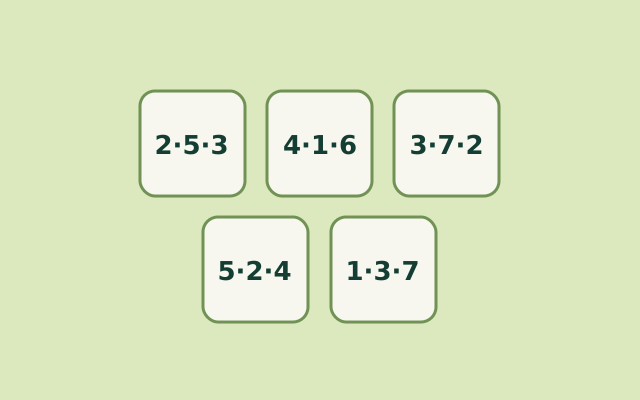 Mobile friendly
Parcel Prism
Parcel Prism is a short daily logic puzzle. Nine parcel cards each carry three numbers: Heat, Lift and Glow. The order at the top asks for an exact total of all three. Pick exactly four cards whose Heat, Lift and Glow add up to the order. Your running totals update as you select, and you can swap cards freely; only pressing Check order counts toward your score. Every board has exactly one solution. Everyone gets the same board each UTC day, your streak is saved in your browser, and you can copy a spoiler-free result to share.
 Mobile friendly
Vowel Ferry
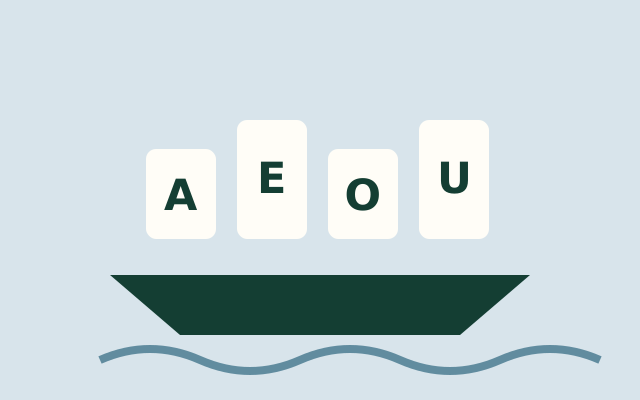
Vowel Ferry is a calm daily word puzzle. Six English words have each lost one vowel, and every word comes with a short definition. A shared cargo holds exactly the six missing vowels, with a counter for each of A, E, I, O and U. Select a word, then move a vowel from the cargo into its blank. Changing a letter sends the old vowel back. When all six blanks are filled, check the cargo; fewer checks means a better result. There is no timer and no guessing of hidden words. A new set arrives every UTC day and your streak stays in your browser.
 Mobile friendly
Gust Grove
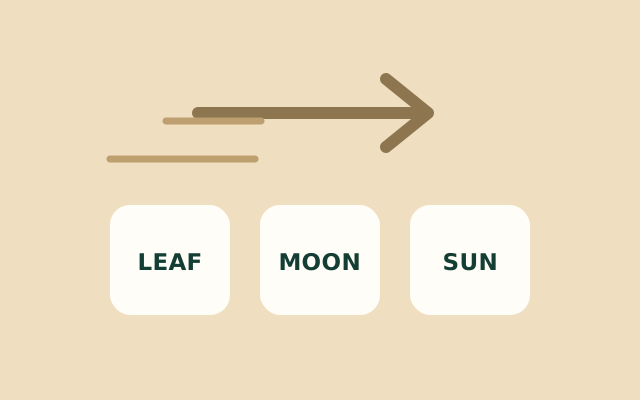
Gust Grove is a quick daily reflex game of 18 cues. Each cue names a symbol, Leaf, Moon or Sun, and shows three landing places in a new order. Find the symbol, then follow the wind: on a calm cue land on the symbol itself, on a left gust land one place to its left, on a right gust one place to its right. The ends wrap around. You have two seconds per cue, and your score is the number of correct landings out of 18. You can pause at any time, and hiding the tab pauses the game. Everyone plays the same route each UTC day.